

 Italiano
Changing room lockers: characteristics, uses, and legal requirements
September 2025
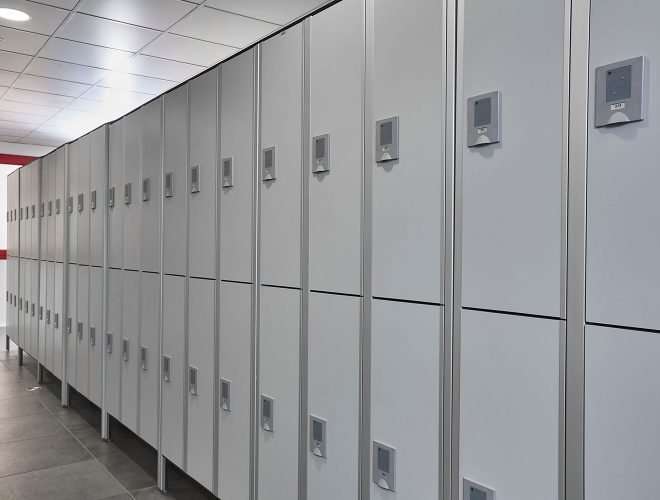
From companies to gyms, from swimming pools to spas and wellness centers, lockers are a furnishing element that can adapt to the needs of various sectors. Compared to standard home furnishing lockers, they are made of particularly robust and stress-resistant materials, and must specifically meet the requirements of the law.
Characteristics of Lockers
From 30 to 50 cm deep, lockers can be made of various materials such as aluminum, laminate, stainless steel, or the more modern HPL plywood, which guarantees maximum resistance to water, humidity, and corrosion. and even chemical agents.
Highly customizable in color, thanks to the infinite modular combinations and customizable dimensions, the lockers adapt to any situation and use, in some cases even integrating accessories such as coat hangers and benches, to maximize space savings and provide the locker room with an airy and livable space.
Finally, maximum attention is paid to security, with the option of using padlocks, manual combination locks, or electronic locks.
Locker Room Lockers: Legal Standards
When it comes to lockers and legal standards, most questions always revolve around one fundamental aspect: within what size limits can my locker be considered compliant?
Fortunately, a quick reading of the regulations is enough to understand that there is no specific range of measurements to determine when a locker can be considered compliant. These lockers are considered compliant, so all sizes are acceptable as long as the locker is large enough to hold the user's clothes and bags.
Particular attention is paid to user privacy: each locker must be equipped with a locking mechanism, although it is not specified whether it is a padlock, manual lock, or electronic lock.
The Various Uses of Locker Rooms
Thanks to attractive lines and durable materials, locker rooms can be a satisfying solution for the needs of even the most diverse environments.
Through a good level of customization and various configurable combinations of sizes and colors, locker rooms are sturdy enough to be used, for example, in schools. However, thanks to the careful design of the more modern models, they can also be used in public spaces. Recent models also represent an ideal solution for spas and wellness centers.
Often made of certified antibacterial, self-extinguishing, and durable materials, locker rooms are perfectly compatible with hospital hygiene requirements.
Search
Categories
Other posts from the blog



November 08, 2025
September 21, 2025